

About Fugleviglund
Get to know us and hear the story behind our location and passion.
About us
Let us introduce our hosts here at Fugleviglund. Our names are Michael and Poul. We have moved to Funen from Surrey in England, and with Fugleviglund we want to create a more down-to-earth connection to the things we do and at the same time find a sanctuary in a beautiful natural setting.
Michael was born to Dutch/Irish parents but grew up in several southern African countries, mainly South Africa. His passion is orchids, but also plants and nature in general. He has written 15 books on orchids and is considered among the specialists in today's world. He therefore participates as a judge in many major international exhibitions such as the World's Fair.
Poul is originally from Vissenbjerg, more specifically he grew up in Andebølle just outside Vissenbjerg. After many years abroad, first in France and Ireland and for the past 20 years in England, where he has worked in sales in the IT industry. With a desire to try something different and at the same time as his roots began to pull at him, he decided to return to the region.
We are both foodies. We love honest food made from good ingredients, and we want to reflect that with what we offer in our café. The opening of Fugleviglund is the beginning of a new journey for us, so we will certainly see an evolution in what we offer, both in the café and the farm shop. There will be items in between that are characterised by our travel activities. We will continuously try to adjust our offering according to the demand we sense there is. But the common thread is to create an overall experience, to be able to share the beautiful nature in the area, offer a refreshment and something good to satisfy the appetite, and at the same time be able to offer some goods that are largely local from Funen, but not exclusively. The common denominator will be quality and revolve around food, kitchen and flowers/plants as well as creating a small environment for togetherness, well-being and cosiness.
History of Fugleviglund 1898-65
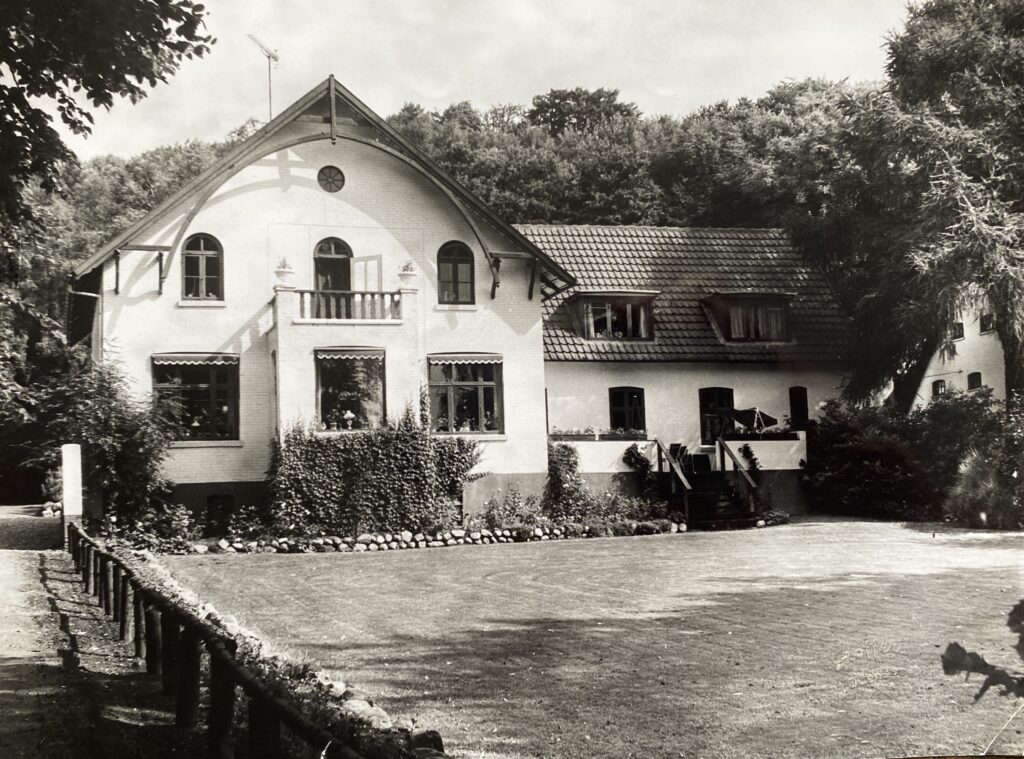
Two generations resided at Fugleviglund during this period. In 1898, the farm was taken over by Christian Frederik Scherfig, who bought both Bred Teglværk and Fugleviglund with its 75 acres of land. The buildings as they stand today were built in the following years. Both a new stable and barn as well as a wagon shed were built in addition to a two-storey extension to the main building.
The brickworks was quickly modernised to become one of the most modern brickworks of its time, and a tramway was installed from the official railway all the way to the brickworks. While a lot of the clay came from Fugleviglund, the rest of the land was cultivated under the expert guidance of Christian Scherfig's wife Ingeborg Scherfig, who also managed the large household with both cook and maid. She created a loving home for her 5 children. She was deeply interested in providing for them and getting them an education, and she arranged for a tutor to give private lessons in the home.
Ingeborg also wanted her children to learn to dance, so she set up a dance school at Fugleviglund for her own and her friends' children. So the property found many different forms of activity during this time.
The four eldest children continued their lives as pastors' wives, engineers, doctors and teachers, while the youngest daughter Grethe, who took a job as a nanny in Copenhagen and also pursued her great interest in gymnastics, returned home to Fugleviglund to take over the farm household after her mother's sudden death. Her interest in gymnastics resulted in the establishment of a gymnastics team for girls at Vissenbjerg Kro, which later moved to Bred Kro. This was followed by a gymnastics class for boys and a series of courses in folk dancing.
It was at one of these folk dance evenings that Grethe Geisshardt met her future husband Walter Robert Geishardt. He was a Viennese child and in 1921, aged just 9, he was taken into care at Holmegården by Thomas and Astrid Jensen. They married in 1934 and continued to run Fugleviglund. The brickworks had already been sold off in 1918, but Walter Geishardt now began to revitalise agriculture, which had been neglected in recent years. Christian Frederik Scherfig continued to live on the farm, but as time progressed, there was some friction between the generations and they then occupied different parts of the large house.
In 1942, things changed dramatically when Walter Geisshardt, a German citizen, was called up for military service in Germany. He had applied for Danish citizenship but had not been able to obtain it under the rules at the time. So he had to go to war for Germany.
It was a tough period for Grethe Geisshardt. Alone with two minor children and a severely calcified father, she had to manage the farm at the same time. However, she found two Jutland farmers who had completed a stay at Tommerup Efterskole to come and help her. She also still had a young girl in the house.
In January 1946, her father died and in May of the same year, Walter returned home from the war. Fortunately, he was physically healthy, but with deep wounds in his mind from his experiences in the war. Grethe Geisshardt managed to continue life at Fugleviglund and found several ways to make ends meet, including being one of the first to set up rooms for city dwellers who wanted to go on farm holidays. She had 7 beds for such guests on the farm.
In 1964, Walter Geisshardt was so troubled by a bad heart that the family had to sell Fugleviglund and moved to a newly built detached house in Vissenbjerg.
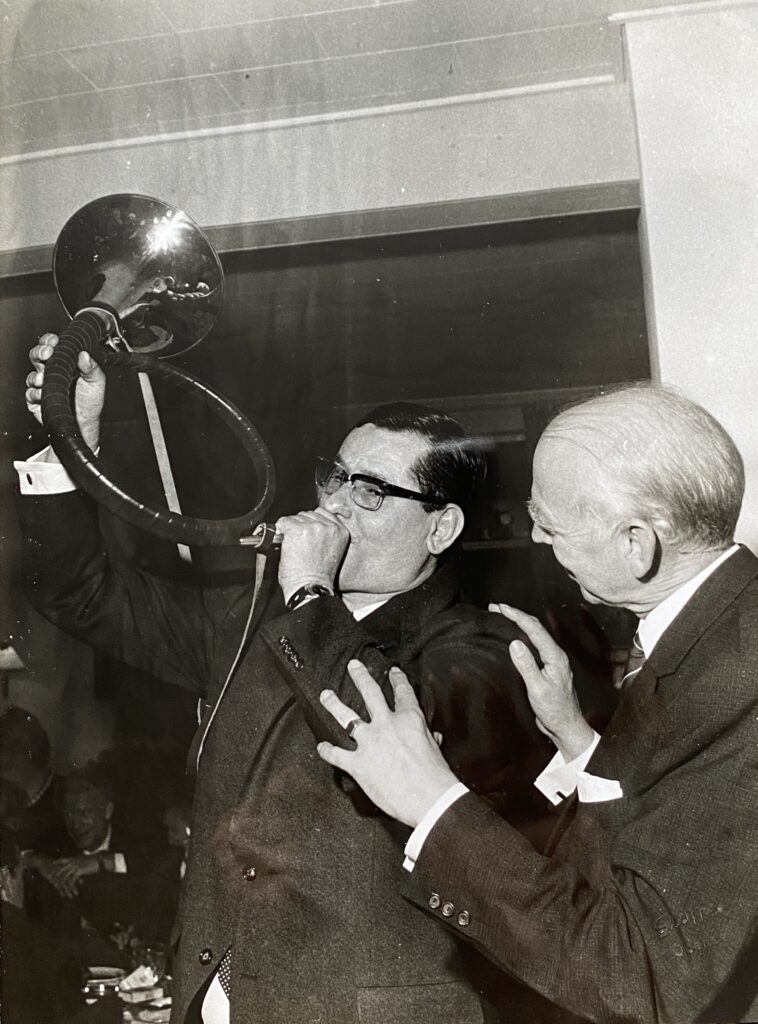
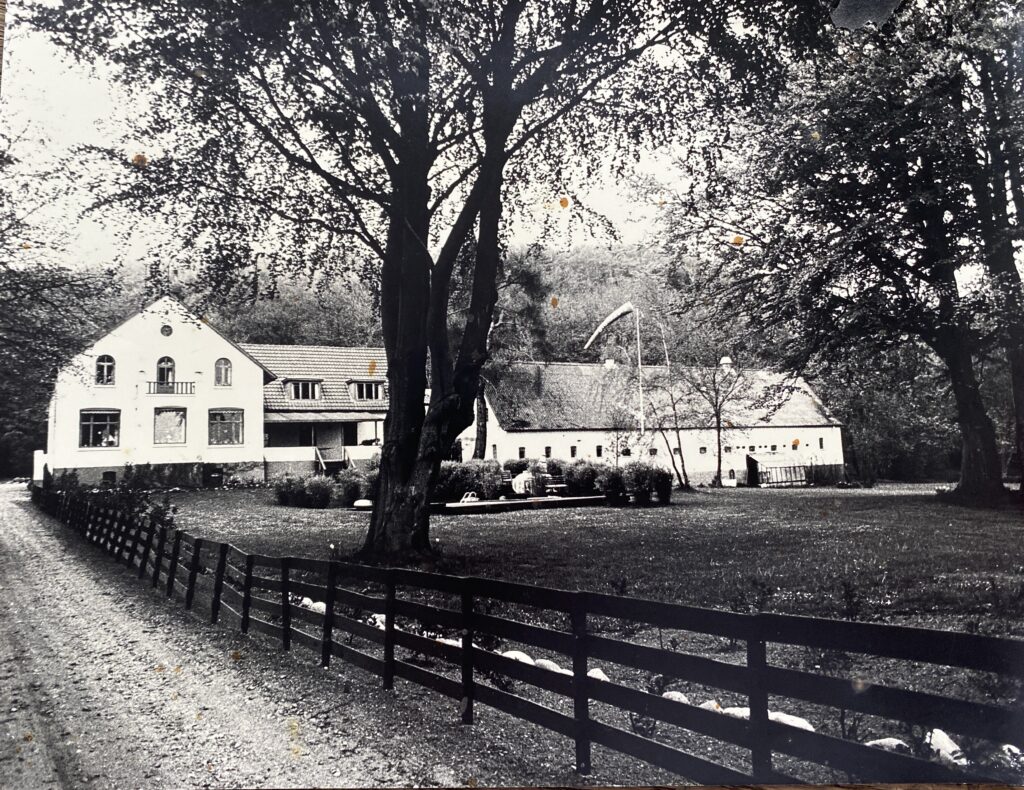
History of Fugleviglund 1968-79
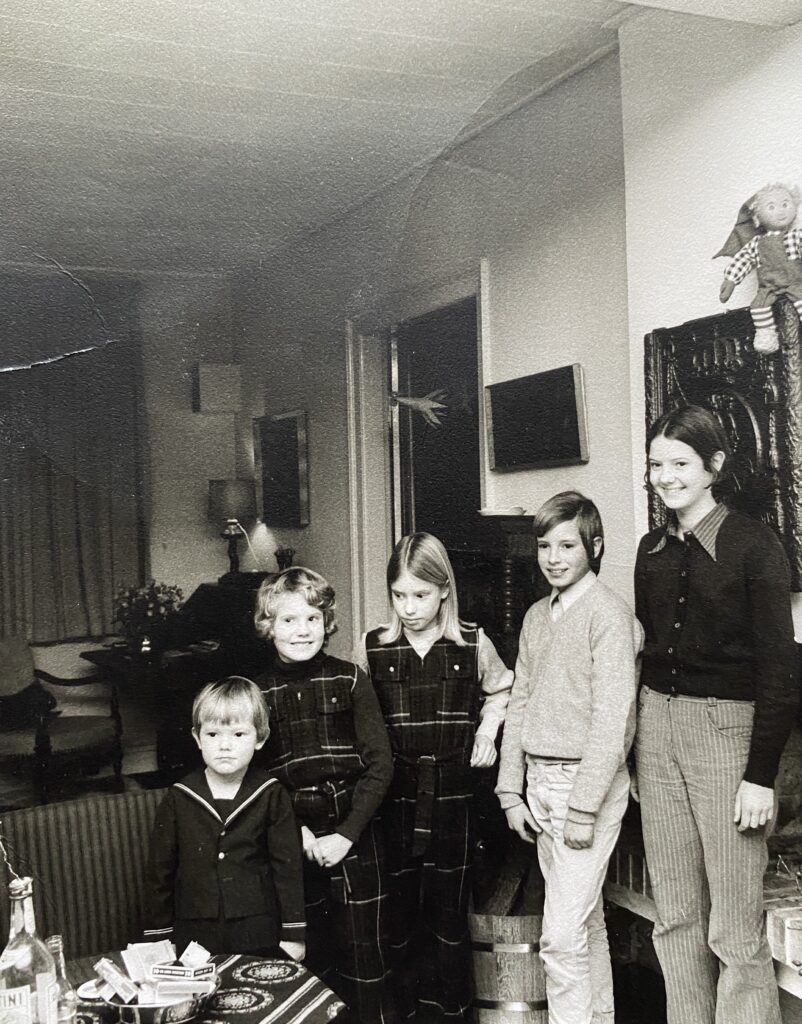
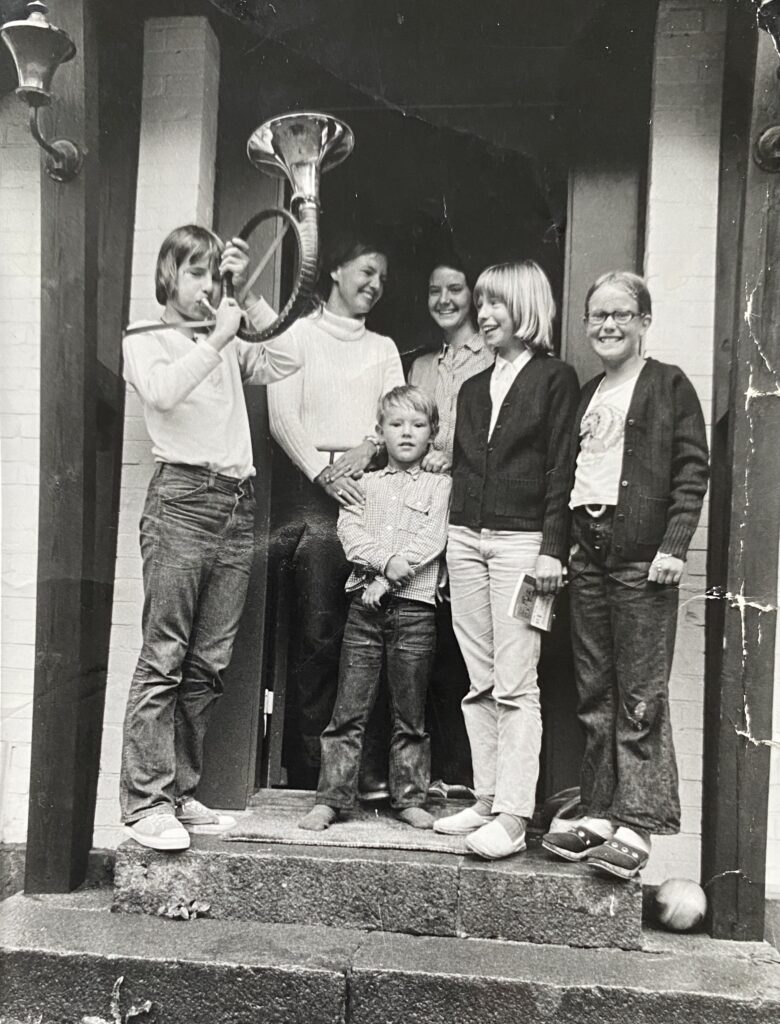
Peter and Bente Stokkebye bought Fugleviglund in the summer of 1968. With five children aged two to thirteen, they were looking for a home that could accommodate a large family. Although both Peter and Bente were from Odense, where they met as childhood sweethearts, they wanted to live in the countryside. Fugleviglund was perfect.
What they took over was a farm and they wanted to run it that way, both with animals and plants.
The goal was not to make a living but to utilise all the farm's facilities. Peter was the third generation of a well-known tobacco family in Odense, where the main income for the family was earned. But nevertheless, investments were made in dogs, horses and thousands of chickens, as well as plant production of holly, snowberries and fir trees. Stables and fields were used. There was an apple orchard at the end of the barn and ducks were put in the lake.
The nature around the farm with the forest up to Vissenbjerg was also utilised. Every New Year's Day, trees were cut down for later consumption. It was traditional for the men to go to the forest and Bente would prepare a winter stew in the meantime. After the chainsaw was switched off, there was Gammel Dansk and beer for the hard-working men. Later in the evening they played pirate bridge, which later became the family's favourite game.
Peter and Bente had many guests at the farm, both personal friends and many business associates from England, Germany and the United States. There was always life and happy days on the farm. This hospitality and inclusiveness meant that the five children, Elizabeth, Erik, Christine, Charlotte and Lars, brought openness and tolerance to their own adult lives. And their mother, Bente, also reached out to other children who came to the farm for summer holidays through the Save the Children organisation.
The eleven years at Fugleviglund was the place where the members of the Stokkebye family gathered, laughed and lived, which spread to all those who came and went at Fugleviglund.
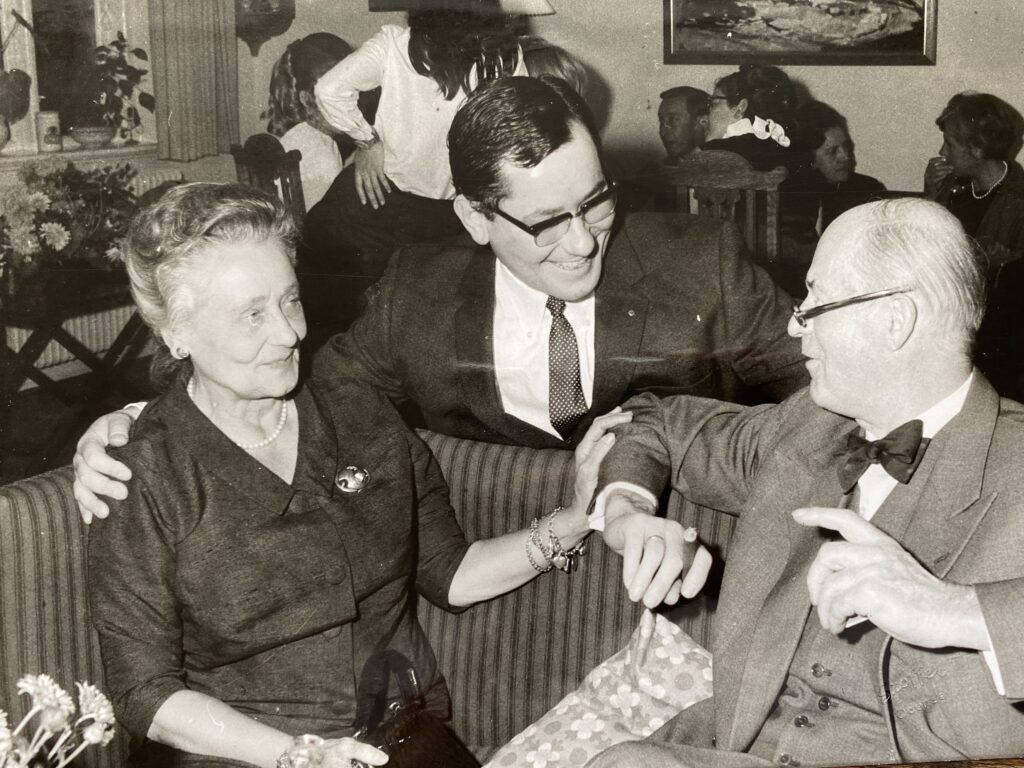
History of Fugleviglund 1979-2020
The time as a production college described by former principal Inger Poulsen.
In the late 1970s, like everywhere else in the country, there was high youth unemployment on Højfyn. Otto Dalgaard, who also became the school's first principal, outlined a project for 16-19 year olds who were not motivated to continue in education directly after primary school. The project was presented to Vissenbjerg and Tommerup municipalities. They liked the idea and started looking for suitable premises. Fugleviglund was chosen. It caused a stir among the locals - they couldn't imagine that this beautiful property would be used for young people who didn't follow the straight path. Nevertheless, it became a reality. Otto, a bricklayer on a job offer and 7 young people set about remodelling the premises to make it fit for purpose. A metal workshop was established, an agricultural team and a teacher was hired for guidance and teaching. In January 1983, I was employed as a teacher. In February 1983, the project became a production college with state subsidies. We had 18 students and 3 employees. In addition, we had 3-4 on job offers.
We needed something for the girls and in 1986 a textile and wood workshop was established. We wanted to expand the student group further and in 1987 the municipality of Årup joined us. By 1988, we had 30 students and the target group had expanded to 16-25 year olds.
We now had a metal workshop, a wood workshop, an outdoor team, a textile workshop and a kitchen, later we also got an IT workshop. We were now using every square metre. We couldn't expand as Fugleviglund is located in a protected area. For many years we had 38-42 students at the school, the physical environment was not suitable for more, so we had a waiting list.
Otto Dalgaard chose to retire in 1995 and Lars Hansen was hired. Lars was innovative and applied for EU funding so that we could set up a project called ”Production School for Adults”, which 10 to 12 mature citizens were referred to. Now the school was really ”full house”. In addition, Fugleviglund also became responsible for basic vocational training (EGU) in the three municipalities.
In 1995, we got a new Production School Act and we were funded by the state in the form of a taximeter subsidy in relation to the number of students. We were now allowed to admit students from all over the country and not just from the three municipalities. However, the three High Funen municipalities had to pay a basic subsidy for operations. This gave us freedom and any surplus at the end of the year could be transferred to the school's operations the following year.
In 1997, Lars Hansen resigned from his position and I was hired as manager. We continued the safe operation but with new projects within the framework we had. After the municipal merger in 2005, we received more and more students from the new Assens Municipality. We often had a waiting list and that worried us. In addition, the bus connections from the southern part of the municipality were not the best either. In 2010, I was lucky enough to attend the inauguration of the new Job and Competence Centre in Glamsbjerg. I could immediately see that it was built and organised like a production school. I followed it closely and as early as 2011 we had a new labour market law, which meant that the metal and wood workshop that was set up in the competence centre could not be used. Fugleviglund therefore rented the premises and bought a pavilion so we had a unit down there. Suddenly we became a ”big school” with 65-70 students spread across the two sites. In 2014, we learned that the Competence Centre was moving - what about us, we couldn't do without the premises? The board of Fugleviglund was resourceful and offered to buy the entire building from Assens Municipality and in February 2016 we were the owners of just over 1600 square metres of building. Over the next year, we established an SOSU programme and an IT workshop. We now had four programmes down there as well as teaching. We now had 120 students and 25 employees.
As early as 2018, we knew that all the preparatory courses would be merged on 1 August 2019 - we would all be transferred to Preparatory Basic Education (FGU). Even though we had two well-functioning departments, it was decided by the ministry that the FGU schools had to merge their departments so that they were only in one place in the municipality. We had no doubt that we should be in Glamsbjerg, both because of the location and the large and new building stock.
Fugleviglund in Vissenbjerg was to be sold. On the 40th anniversary of the school's founding, it was put up for sale. An era had ended and a new one was about to begin. As manager, I had one big wish - that the new owners would be as happy with the place as we had been all these years.
It was my great pleasure on 1 October 2020 to hand over the keys to Poul Moestrup, as I know that he has the history and will cherish the place, so in this way a ring is closed.